RYT: STRATEGY, PRODUCT & REGULATION
RYT: STRATEGY, PRODUCT & REGULATION
Business challenge: Turn a novel Layer 1 blockchain into real products, a sustainable token economy and regulated financial services, starting in Pakistan: 240M+ people, a large unbanked population and one of the world's biggest remittance markets.
Strategy challenge: The chain's consensus doesn't need staked capital, so the standard crypto playbook for token value, rewards and launch timing didn't apply. Pakistan's virtual asset regulator was brand new, so there was no precedent to follow either.
Solution: Treat the token, the products and the regulatory filing as one system. Design token demand around real usage, build consumer products around financial behavior people already have, and write the regulatory case as openly as possible.
Results: A redesigned token economy and rewards program, a stablecoin and yield architecture built to sit cleanly within the new regulatory framework, a first-of-its-kind sandbox application authored and filed under Pakistan's new Virtual Assets Act, and product requirements for Komiti and the RYT Wallet, unified under a single account.
I joined RYT in May 2025 to run marketing. The rest of this work wasn't in the original job description. Tokenomics, regulation and product all needed an owner who could set the strategy and also do the work, and there wasn't one, so I took them on. The title caught up later: Chief Marketing and Ecosystem Strategy Officer. In practice that meant setting ecosystem strategy at the exec level and doing hands-on product work on the RYT Wallet and ePKR, the rupee stablecoin it carries, and Komiti, our app for onchain savings circles.
Tokenomics from first principles
Most token models assume proof of stake: you lock capital to secure the network and earn yield for it. RYT runs on Proof of Majority, where every node has an equal vote and no stake is needed for security. End users never pay gas. That's a great product story and a hard economic one. If users pay nothing and validators don't need to stake, where does token demand come from?
I led the work with our external token economists. Early on it was clear their model had imported proof-of-stake assumptions that didn't fit the chain. Old habits are hard to break and there was no template for this. So I managed a strategic reset with the partner and took it back to first principles.
How do you monetize a chain that has no gas? And with no precedent to copy, what is the most productive economy you can build from scratch?
We started from the one thing we wouldn’t trade away, the go-to-market promise the chain’s architecture makes possible: RYT will always be free for end users.
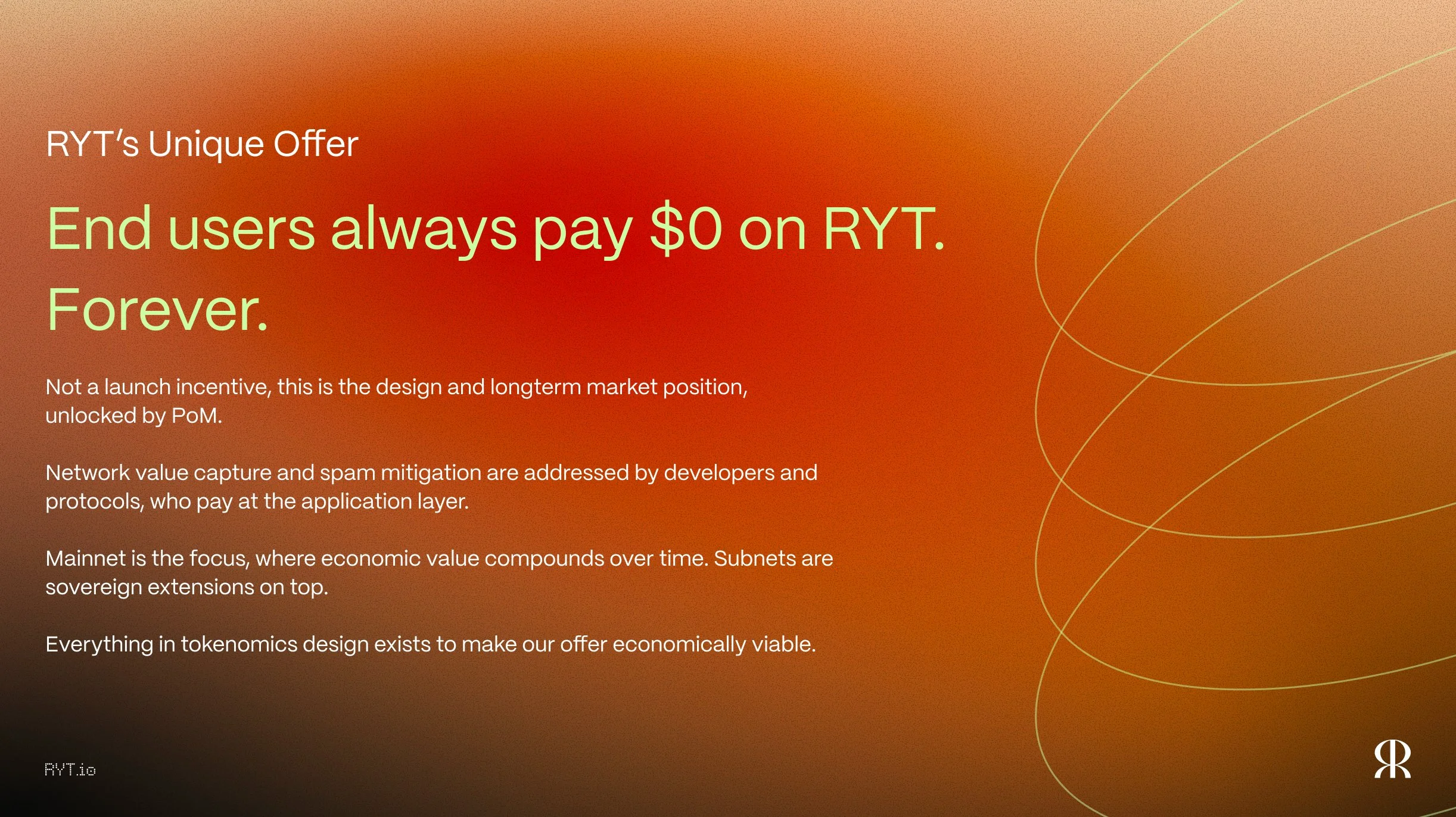
The easy answer would have been to charge users. Every other chain does. But users are the ones bringing the value to the network: their savings, their payments, their activity. Charging them taxes the wrong side of the market. So we flipped it in a way that only an architecturally gas-free chain can. The people who earn from the network pay for it: developers, protocols, onchain businesses and institutions buy metered service credits to use network resources. Sovereign deployments carry a usage budget paid by the customer, which turns government contracts into contracted token demand. In other words, RYT inverts L1 economics.
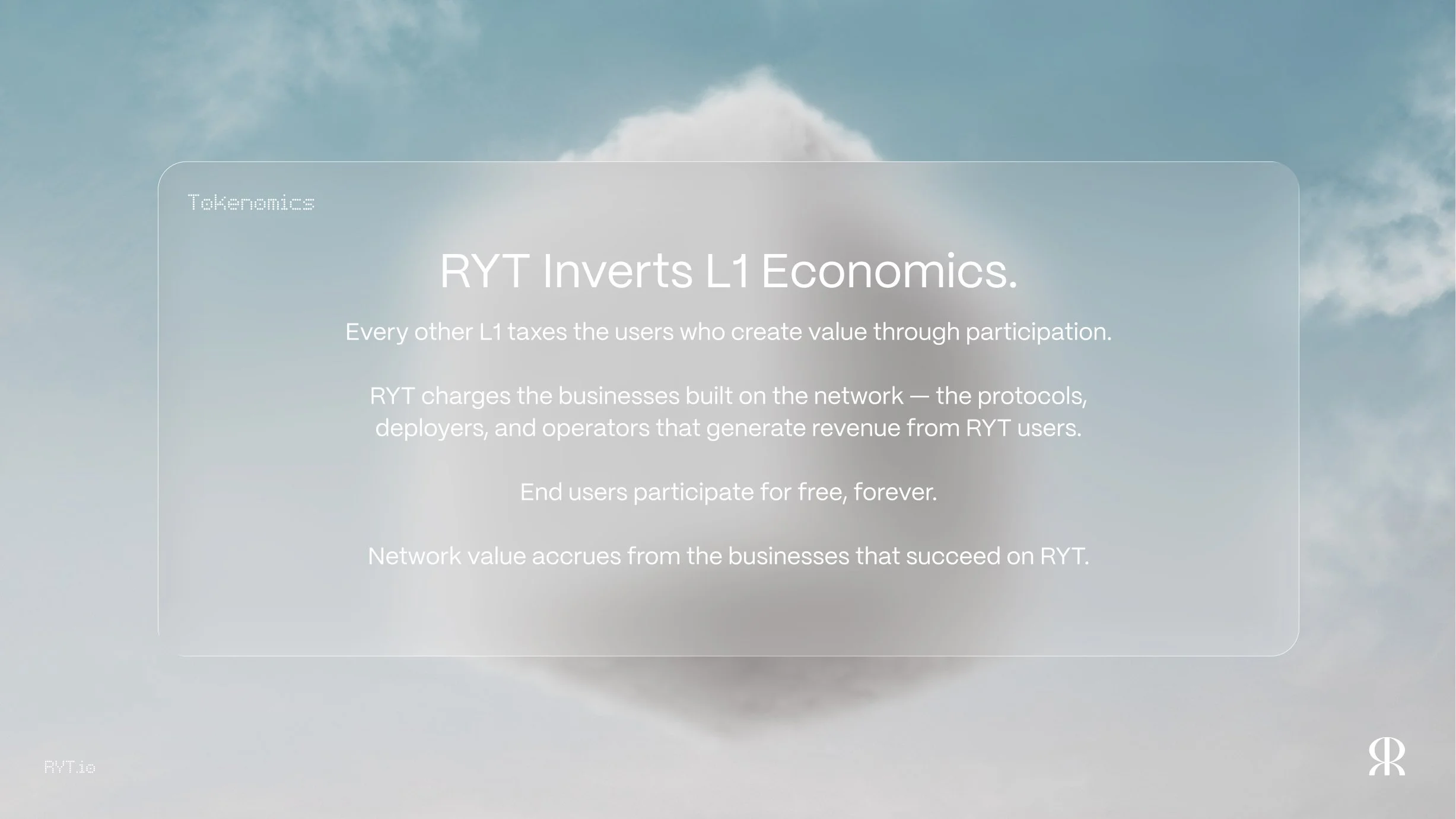
Three decisions shaped the rest of the design:
Codify the promise, then build the economics from it. Free for users wasn’t a launch subsidy we’d quietly remove later. It was the first principle, the constraint everything else had to work around, so value capture had to come from the businesses that profit from the user base.
Sustainability over emissions. Fixed supply, no inflation. Onchain usage burns tokens, and off-chain fiat revenue from sovereign and enterprise contracts funds buybacks, so value accrues whether a customer pays onchain or by bank wire. Launch rewards stimulate early demand, then taper off as a bridge into real revenue instead of becoming permanent token inflation.
Launch on performance, not the calendar. After analyzing outcomes from 125 token launches in 2025, I argued that the token generation event should be a business milestone, triggered by traction, not a date picked in advance to suit a fundraising timeline.
To pressure-test the model, I ran a blind review panel of three independent AI reviewers, each with one lens: mechanism designer, skeptical investor and go-to-market realist. I combined their findings into one prioritized list and recorded a decision against every item. It's now my standard way to stress-test a strategy before it goes in front of people whose time is expensive.
A go-to-market built for users, not speculators
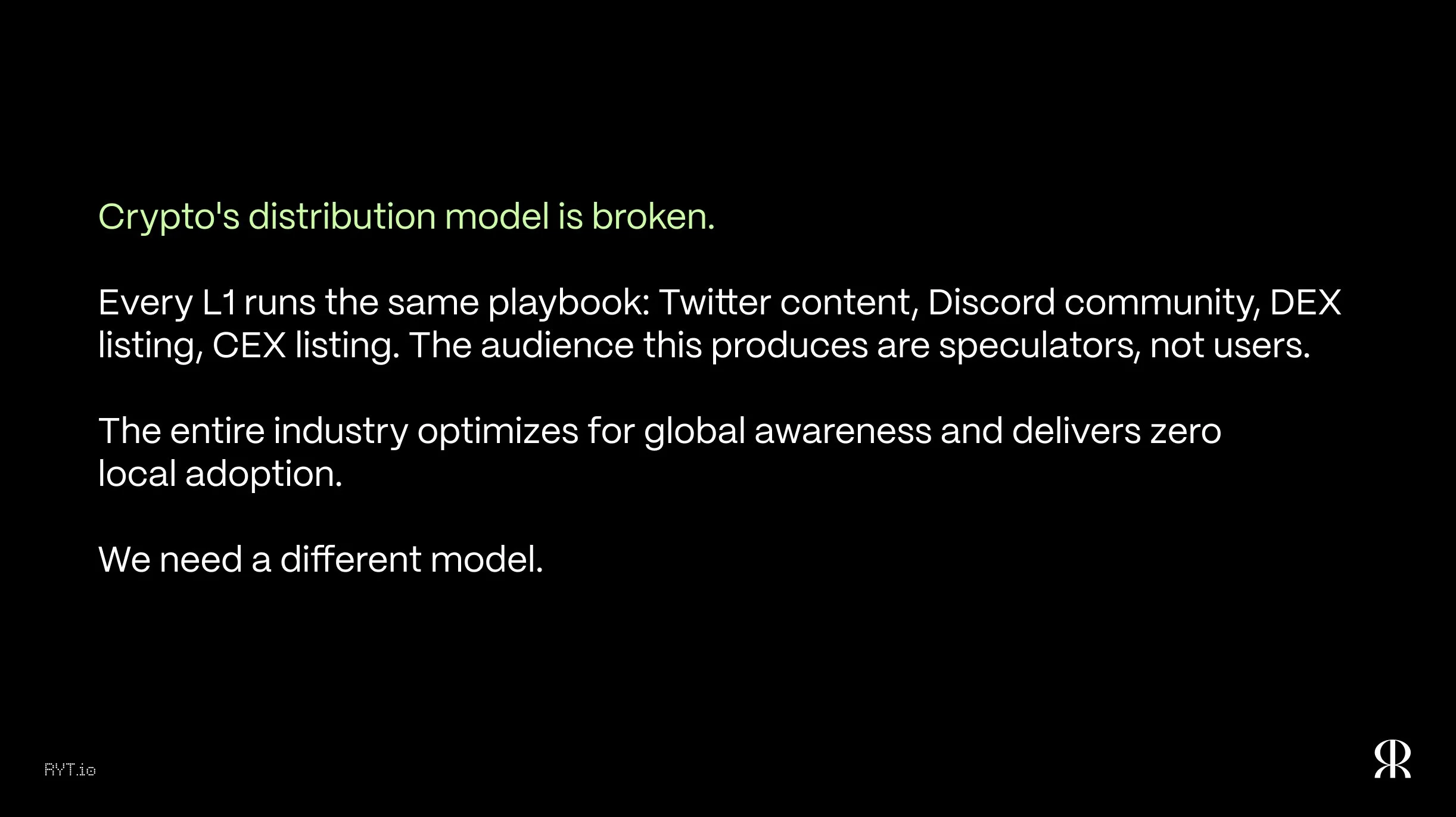
Crypto's distribution model is broken. Every L1 runs the same playbook: content on X, a Discord community, a DEX listing, then a CEX listing. It produces speculators, not users. The industry optimizes for global awareness and delivers almost no local adoption.
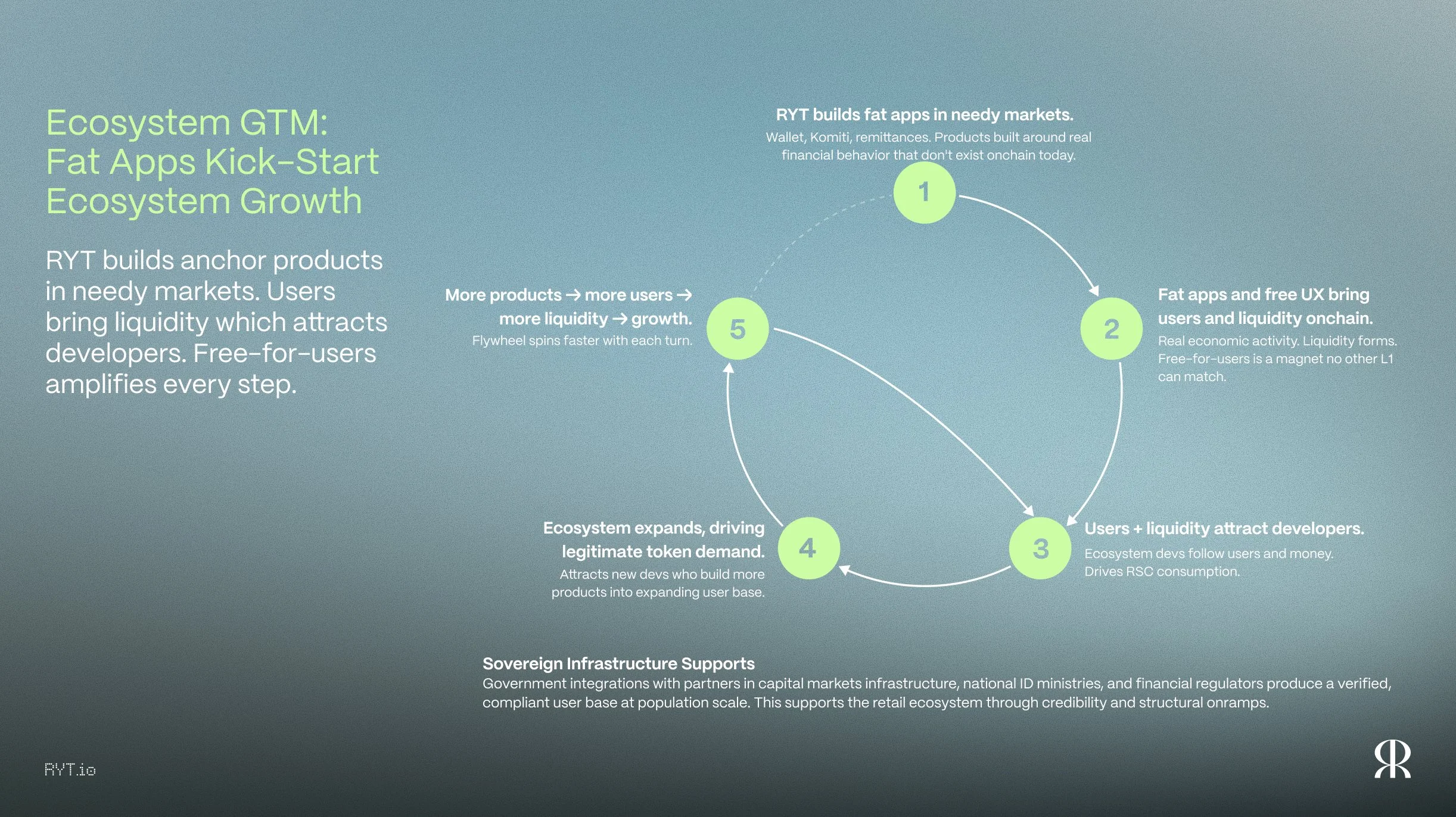
I proposed a different model: treat crypto marketing like consumer marketing in a specific geography. One market, Pakistan. Products built around financial habits people already have: mobile money is how people actually move rupees, and committees (rotating savings circles) are a centuries-old way to save. No crypto vocabulary anywhere. Distribution through the 200,000+ mobile money agents who already turn cash into digital balances, which looks more like retail than crypto. Tron became the world's dominant retail settlement layer for stablecoins with a similar ground-level strategy.
That gave us two strategies and one plan. Globally, we speak to investors, builders and institutions on X, LinkedIn and at events. Locally, we speak to savers on WhatsApp and YouTube, in Urdu, and through agents. One number connects them: Pakistan's active users become the proof point the global audience cares about.
The token follows the same logic. Standard airdrops attract mercenary capital, so rewards in our apps are opt-in, off by default, and weighted toward real balances and completed committee cycles, which take months of coordinated payments and are nearly impossible to fake. Komiti earns, the wallet collects. Cross-sell is built into the incentive, not bolted on as a marketing push.
ePKR and the RYT Wallet: a stablecoin people can actually use
The RYT Wallet is the consumer home for ePKR, and I own it end to end: strategy, design, requirements, onramp and custody decisions, and GTM. We chose a native, non-custodial wallet over smart-wallet and MPC options and kept crypto vocabulary out of the interface entirely.
The savings product started as my proposal. In April 2026 I pitched a yield-bearing savings product as a second on-ramp alongside Komiti. Committees spread through social networks, while savings could spread through agents with a one-line pitch: earn more than a bank, no bank account needed. It became the core of the wallet.
Most stablecoin designs assume Western rails: bank accounts, card networks, wire transfers. That isn't how money moves in Pakistan. Mobile money is. JazzCash and Easypaisa are everywhere, and agents on street corners turn cash into mobile balances. So ePKR's ramps are mobile money. Users fund from their mobile wallet (or pay cash at an agent who does it for them), and redemptions go back to the same account. Nobody sees the words "stablecoin" or "blockchain." From the user's side, it's a rupee balance that earns.
Earning was the point. Without yield, a digital rupee wallet has no advantage over the mobile money app already on your phone. But the savings products those apps offer make you choose: to earn a return, you lock your money up for a fixed term. We wanted both: yield with no lock-up and instant redemption, 24/7.
That's what the vault is really for. It's less a financial product than an accounting tool. Opting into yield is a behavioral signal. Vault holders are stickier savers, and non-vault holders are transactional. Separating them let us model how much money actually needs to sit in cash at any moment to pay out instantly, and how much can safely be in T-bills earning. Without that, every redemption would wait a day for T-bills to be sold.
A Shariah-compliant vault is designed alongside it as a separate investment product, since the Islamic instruments available behave differently from T-bills.
Writing the regulatory case
In 2026 Pakistan passed its Virtual Assets Act and set up a new regulator, PVARA, with a regulatory sandbox. I authored RYT's sandbox application for a PKR-backed stablecoin and its supporting self-assessment, and managed it through several rounds of executive review, an informal pre-filing review with the regulator and the official filing.
The work was a loop with three questions. What does the law say this product has to be? How do we build that on our chain, with banks and local payment rails? And how do we show it back to the regulator as compliant? Some examples:
The token. The Act treats a fiat-referenced token as its own instrument and bans algorithmic designs. So ePKR is backed one-to-one by segregated reserves and redeemable at par, with controls like pause and blocklist enforced in the contract itself. The token contract can't be upgraded, so holders know the rules won't change under them.
The reserves. State Bank rules say client money accounts hold cash in rupees and can't earn a return. That one rule shaped the whole product. Circulating ePKR is backed by cash. Only money a customer explicitly puts into the yield vault goes into short-dated government T-bills. Yield became a separate product by design, not as a workaround.
Identity. We'd originally believed we could rely on the payment rails' own customer checks. Reading the rules closely showed we couldn't. So we rebuilt onboarding around our own checks against the national ID database and a verified funding origin: money only comes in from licensed, ID-verified accounts in the customer's own name. I rewrote the product requirements and moved the change into engineering tickets the same week.
The sandbox itself. The guidelines didn't set test limits, so we proposed our own: a staged test where the second tier only opens with the regulator's written approval once the first tier's targets are met.
Where a rule was genuinely ambiguous, we said so and asked, instead of committing to a position we'd have to walk back. Banks, for example, wouldn't commit to a sandbox participant without a signal from the regulator. We stated that openly in the application and asked PVARA to provide that signal. When a pre-alignment trip didn't produce clear answers, we chose to file a good-faith, work-in-progress application and let the regulator set the bar, instead of waiting.
Komiti: digitizing a savings circle without breaking it
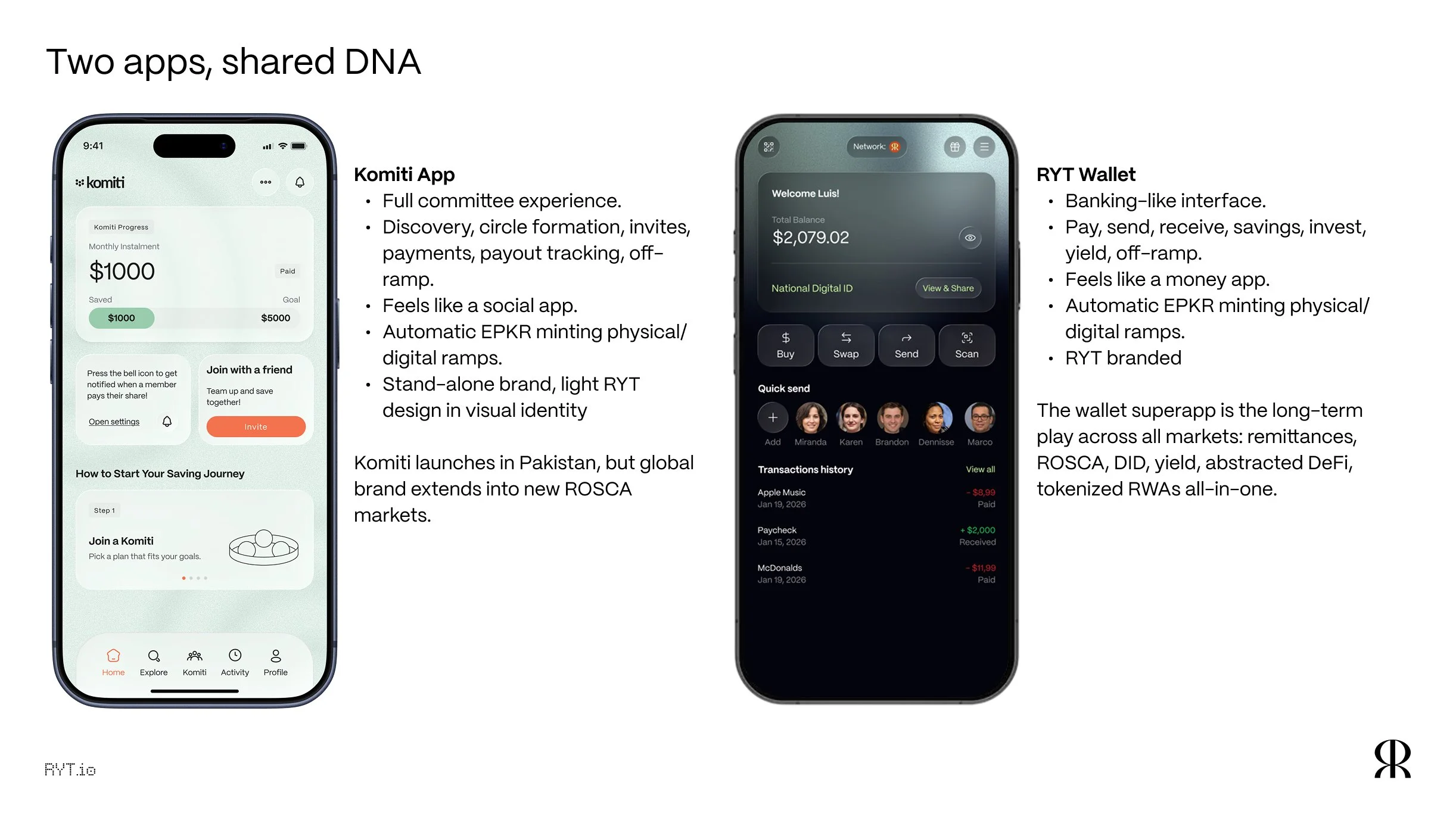
Committees are how a huge share of Pakistanis save. Up to 41% take part. A group of people each put in a fixed amount every month and take turns receiving the whole pot. The existing digital players have barely made a dent, because the real incumbent isn't an app. It's a cash committee run over WhatsApp by someone everyone trusts.
I own Komiti's product strategy and requirements, market research, audience strategy and GTM.
Committees work because enforcement runs on the relationship, not the technology. We needed to understand these relationships before we designed product and messaging solutions around them.
I wrote the research strategy and briefed a Pakistani agency on a robust qualitative research initiative. RYT's team isn't predominantly Pakistani, so I asked the agency to challenge our hypothesis segments rather than confirm them. I also reworked their proposed design around the people who actually make committees work: organizers and real, intact groups.
The product requirements carry the same thinking:
Groups are invite-only and the organizer is rewarded. The organizer recruits the group and gets an early payout position for doing it, which mirrors how committees already work.
Trust you can see. Contributions and payouts are visible to the whole group in real time, and every member carries a reputation score built from their payment history. Default follows the same logic: miss a payment and you move to the back of the line, and you can’t start a new group until you’ve settled the old one. We didn’t promise guarantees we couldn’t back.
The chain sits behind, not in front. After the build kickoff, I restructured the product so the operational database is the record of truth and the chain keeps a transparent mirror of it. Users get speed and simple fixes when something goes wrong, and the group still gets an audit trail.
Local rails first. JazzCash at launch, then other mobile wallets and instant bank transfers, with least-cost routing behind the scenes.
The go-to-market is a focused pilot with local activations. The success metric is active users in active groups, set by what the pilot team can actually support, not by competitors' download counts. Komiti also feeds the wallet: payouts land where they can earn in the vault until they're needed.
One account, one ecosystem
The easiest way to build two products is as two separate apps. Each gets its own signup and its own user table, and each treats the user’s blockchain address as their identity. That’s also how you end up with a customer who saves in a Komiti committee and holds ePKR in the wallet, with neither product knowing about the other.
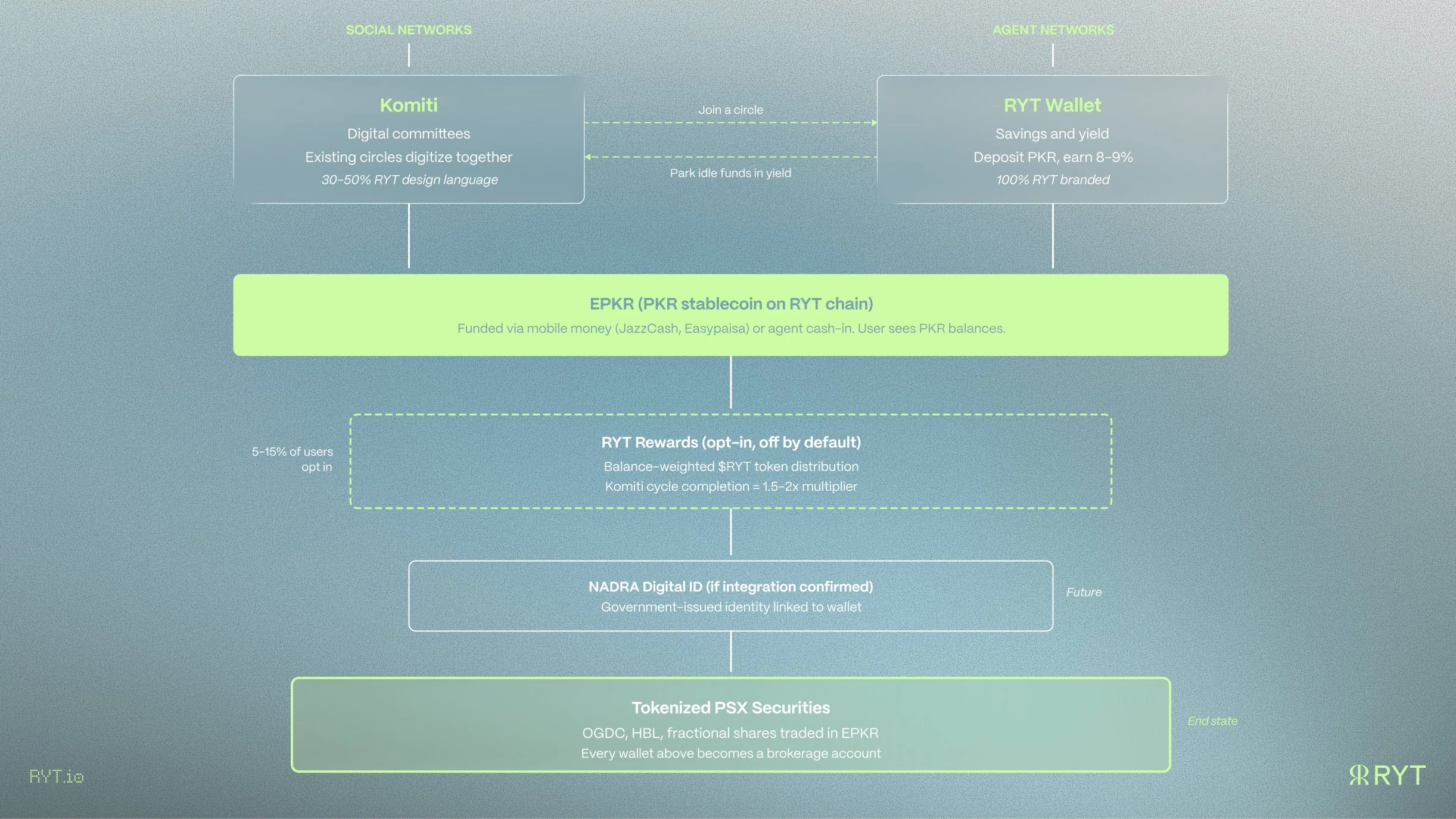
I pushed hard for the opposite. Komiti and the RYT Wallet, which is how people hold and use ePKR, key to a single RYT account. It’s a unique ID tied to the user’s national ID number and mobile number, not a chain address. Whichever product someone reaches first creates the account. The other finds it and attaches to it, and never creates a second one.
Separating the account from the address mattered just as much. Komiti is custodial, so a member can save, contribute and get paid without a chain address ever existing for them. An address only appears when they open the wallet, and it’s generated on their own device, non-custodial from the first moment. The same account carries over when someone changes phones, and a national digital ID issued later lands on the account the person already has. No personal data goes onchain.
That one decision turns two apps into an ecosystem. Committee payouts land in the wallet as ePKR, idle balances can earn in the vault, and compliance checks happen once per person, not once per product.
The end state
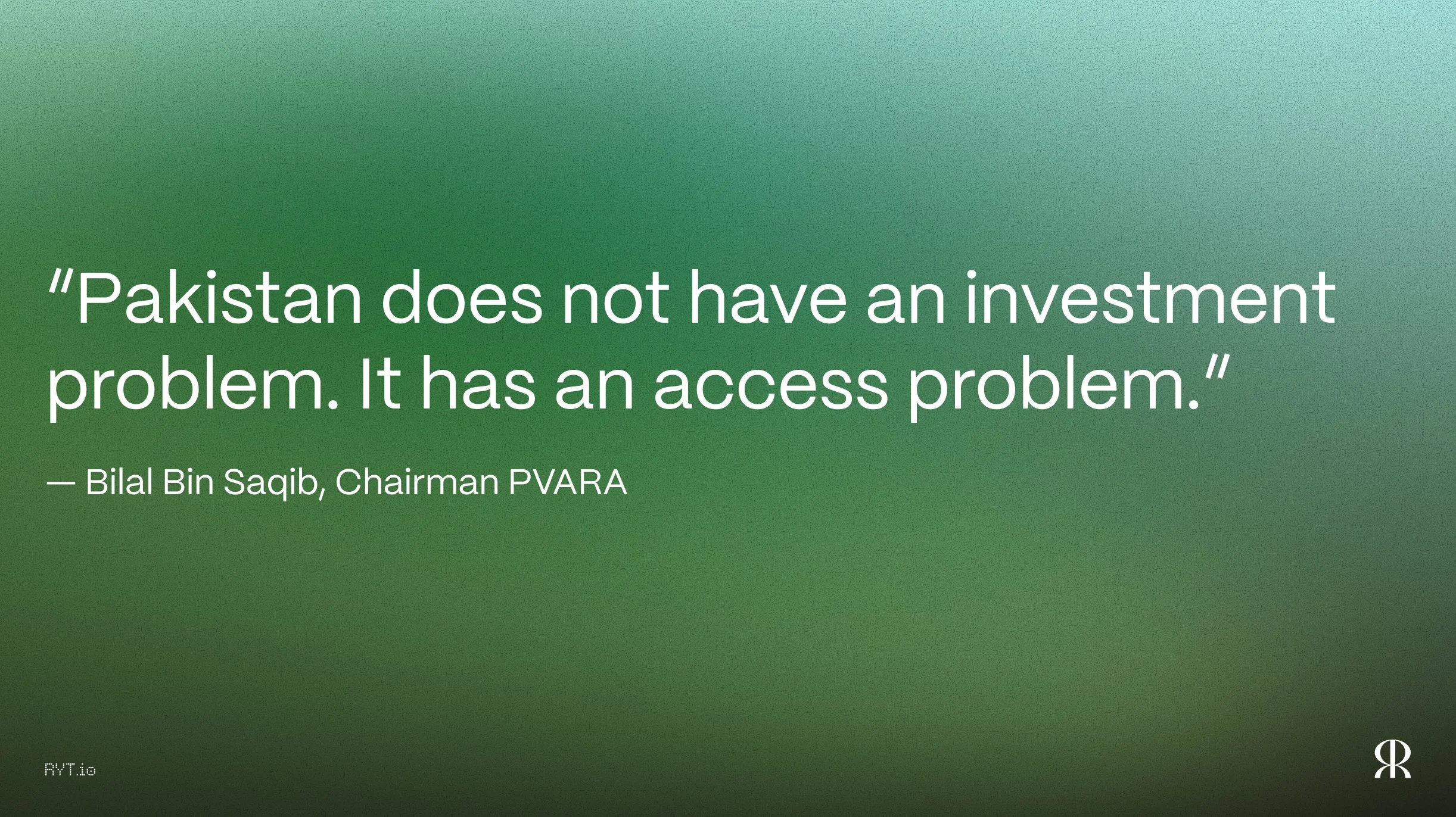
"Pakistan does not have an investment problem. It has an access problem," as PVARA's chairman, Bilal Bin Saqib, put it. Fewer than half a million Pakistanis invest in equities, in a country of 250 million.
Komiti and savings were never the destination. They're how we get verified, funded wallets into people's hands before tokenized securities go live. When they do, every one of those wallets becomes a brokerage account. We're building the Robinhood for Pakistani capital markets.